The short answer
- Hera is ESA’s follow-up to NASA’s DART test, studying the aftermath of the 2022 impact on Dimorphos, the moon of the asteroid Didymos.
- Hera reached the Didymos and Dimorphos system in early November 2026, and DLR reported its first close-up images on November 12, 2026.
- Brian May, a Hera science team member, made 3D views from Hera images, which ESA published on November 19, 2026 as added depth, not a new scientific finding.
- Detailed Dimorphos images are due at an ESA livestream on the evening of Wednesday, November 25, 2026, while ESA lists the mass of Dimorphos as an open question.
Hera is a spacecraft from the European Space Agency (ESA) that is studying the aftermath of NASA’s DART test, in which a spacecraft crashed into the moon of the asteroid Didymos in September 2022. It reached the Didymos system in early November 2026, and it is in the news now ahead of a livestream of detailed Dimorphos images on November 25, 2026. The 3D views were made from Hera data by Brian May, a Queen guitarist and astrophysicist on the Hera science team, who made them with Claudia Manzoni of the London Stereoscopic Company from images taken on November 6, 2026.
Why it's trending
The German Aerospace Center (DLR) reported Hera’s first images of the Didymos and Dimorphos system on November 12, 2026. On November 19, 2026, ESA published an article on Brian May’s stereoscopic views, which ESA presents as adding depth to early views rather than as a new scientific finding.
The next date to watch is November 25, 2026. ESA has invited the public to a livestream on the evening of that day to see the first close-up images of Dimorphos since the DART impact.
What the Hera mission is
Hera is ESA’s follow-up to NASA’s DART test. In 2018, the two agencies agreed the AIDA plan: NASA would test an impact, and ESA would send a spacecraft to study the aftermath, according to The Planetary Society.
Why it exists: the DART test and planetary defense
In September 2022, DART crashed into Dimorphos, the moon of the near-Earth asteroid Didymos. According to The Planetary Society, the impact changed the orbit of Dimorphos. ESA describes Hera as a thorough investigation of a deflected asteroid and the first planetary defense test.
What Hera carries and does
According to The Planetary Society, Hera will orbit the pair for months, mapping Dimorphos and measuring the crater left by DART. ESA lists two open scientific questions: the mass of Dimorphos, and which properties explain how it responded to the DART impact.
The Planetary Society also says Hera is planned to release two small CubeSats, Milani and Juventas, about six weeks after arrival. This timing is not confirmed, so see What happens next. Milani is to study the surface and dust, and Juventas carries a low-frequency radar to probe the interior of Dimorphos.
Launch and arrival
Hera launched on October 7, 2024. The Planetary Society gives November 5, 2026 as the arrival date, while DLR describes the arrival as early November 2026. ESA says Hera has arrived at Dimorphos after a two-year journey through deep space.
What the asteroid system is: Didymos and Dimorphos
Sizes and why a binary matters
Didymos is about 780 m across. Dimorphos is the smaller body that orbits it. DLR gives Dimorphos a width of 151 m, while The Planetary Society gives about 160 m, so readers should treat the figure as roughly 150 to 160 m. DLR uses the term binary asteroid system for the pair. The pair matters here because the 2022 impact changed Dimorphos’s orbit around Didymos by more than 30 minutes, according to The Planetary Society, and Hera is studying the aftermath of that change.
What has been found so far
The 3D views discussed below are not a new scientific finding: ESA frames them as adding a dimension to early views.
First images (November 12 and 17, 2026): a side of Didymos not seen by DART
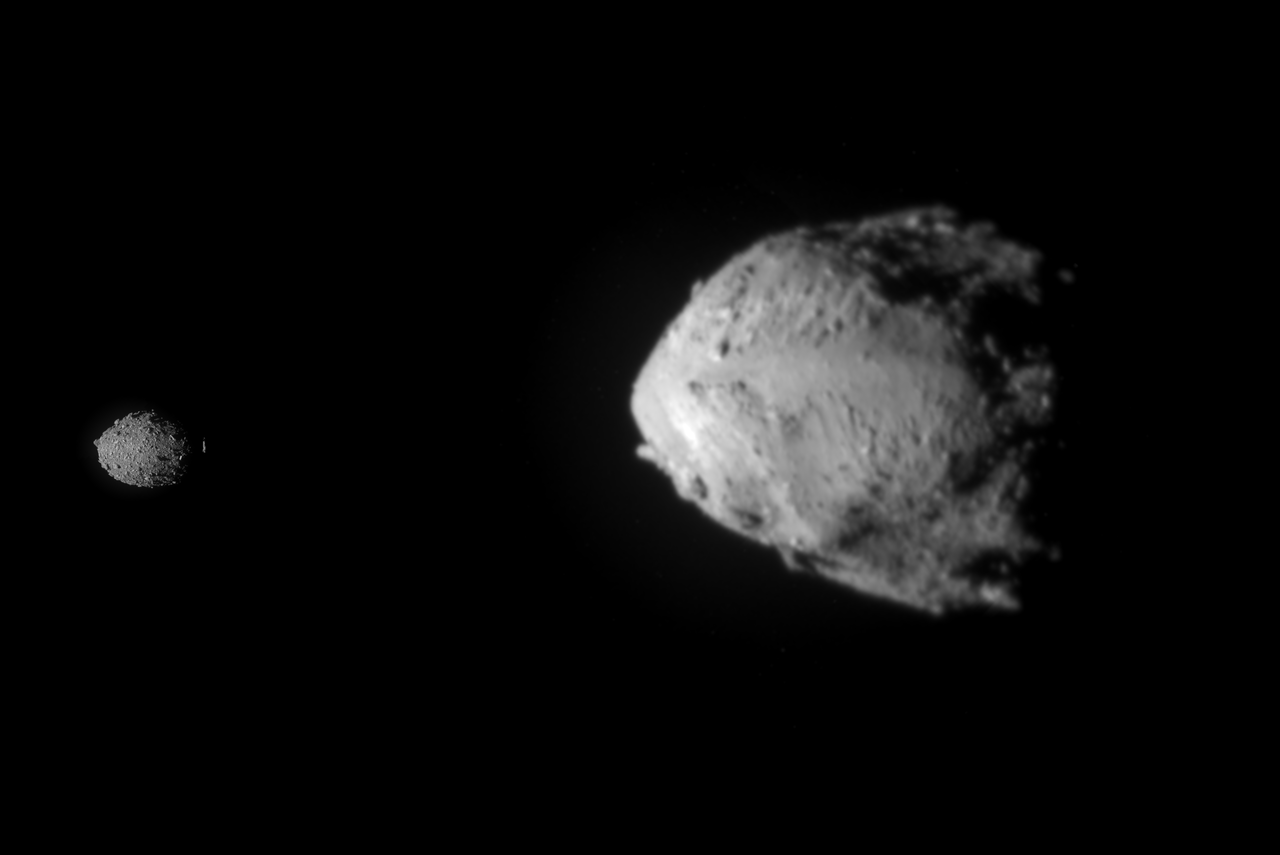
DLR reports that the first close-up was taken by the monochrome Asteroid Framing Camera from 60 km away. In that image, Dimorphos is mostly in shadow, while Didymos is visible. As of November 21, 2026, a DLR update dated November 17, 2026, reported in a search snippet rather than the full page, says the image shows a side of Didymos that DART’s camera could not see before the 2022 impact. Treat this detail as lower confidence.
Brian May’s stereo views (images from November 6, published November 19, 2026)
ESA reports that Hera’s Asteroid Framing Camera took the two source images on November 6, 2026, while the spacecraft circled Didymos at 29.7 km, with a resolution of 2.8 m per pixel. May produced the 3D views with Claudia Manzoni of the London Stereoscopic Company, using adjacent frames taken moments apart.
Patrick Michel, Hera principal investigator, says the stereo pairs let people feel “as if there”. ESA notes that the images come from about 197 million km away. ESA lists three ways to view them: the parallel-eye method, the cross-eyed method, or a dedicated viewer.
What has not been found yet
ESA lists the mass of Dimorphos, and the properties that explain how it responded to the DART impact, as open questions. The Planetary Society says Juventas carries a low-frequency radar to probe the interior of Dimorphos, but the sources reviewed do not report any interior results.
The Planetary Society says Hera will orbit the pair for months, so answers are unlikely to come quickly. This is an inference from that description, not a published schedule.
What happens next
The November 25 livestream
ESA invites viewers to a livestream on the evening of Wednesday, November 25, 2026, to see the first close-up images of Dimorphos since the DART impact. ESA describes the event as sharing first images. As of November 21, 2026, the exact start time is not confirmed in ESA’s text, so check ESA’s event page before the broadcast.
CubeSat release and close-range survey
As of November 21, 2026, the CubeSat release, planned for about six weeks after arrival according to The Planetary Society, is unconfirmed.
Separately, as of November 21, 2026, DLR says Hera will carry out a “crash site investigation” of Dimorphos from close range over the coming months, using several instruments. This is a DLR claim that has not yet been fully verified. For updates, the ESA and DLR news pages are the primary sources to check.
Questions people ask
What is the Hera mission?
Hera is ESA’s spacecraft that follows NASA’s DART test. Under a 2018 plan called AIDA, NASA tested an impact and ESA sent Hera to study the aftermath. It is designed to map Dimorphos and measure the crater left by DART.
What did DART do to Dimorphos?
In September 2022, DART crashed into Dimorphos, the moon of the asteroid Didymos. According to The Planetary Society, the impact changed the orbit of Dimorphos. Hera is now studying the results of that impact.
What has Hera found so far?
DLR reported Hera’s first close-up images of the Didymos and Dimorphos system on November 12, 2026. Brian May’s 3D views, based on images taken on November 6, were published by ESA on November 19, 2026. ESA presents these as added depth, not as a new scientific result.
When can I see the new Dimorphos images?
ESA has invited viewers to a livestream on the evening of Wednesday, November 25, 2026, and DLR says detailed images will be released that day. The exact start time is not confirmed in ESA’s text, so check ESA’s event page before the broadcast.
Sources
- Sir Brian May adds new dimension to Hera asteroid — ESAesa.int
- Watch live: Hera's first images of post-impact asteroid Dimorphos — ESAesa.int
- Hera spots its target – a first glimpse of the Didymos and Dimorphos binary asteroid system investigation — DLR (German Aerospace Center)dlr.de
- Hera, ESA's asteroid investigator — The Planetary Societyplanetary.org